Most industrial motors are designed to run at a fixed speed directly from mains power — but most real processes don’t actually need a fixed speed. A conveyor might need to slow down for a delicate product and speed up for a heavy one. A pump might need to match demand instead of running flat-out constantly. The device that makes this possible is the frequency inverter, and it’s one of the most impactful pieces of technology in modern automation.
What Is a Frequency Inverter?
A frequency inverter — also called a variable frequency drive (VFD) or variable speed drive (VSD) — is a device that controls the speed and torque of an AC motor by varying the frequency and voltage of the electrical power supplied to it. Instead of a motor running at one fixed speed determined by the power grid’s frequency, an inverter lets that speed be adjusted anywhere from a slow crawl to full speed, on demand.
How Does It Actually Work?
A motor’s speed is directly tied to the frequency of the AC power driving it — standard mains power runs at a fixed 50Hz or 60Hz, which is why an uncontrolled motor only really has one speed. A frequency inverter changes this by converting power in three stages:
1. Rectification
Incoming AC power is first converted into DC power using a rectifier circuit.
2. DC Bus / Filtering
That DC power is smoothed and stored briefly on the “DC bus,” providing a stable power source for the next stage.
3. Inversion (PWM)
Power electronic switches (typically IGBTs) rapidly turn the DC power back into AC — but using Pulse Width Modulation (PWM) to synthesize a new, adjustable frequency and voltage. This synthesized AC waveform is what actually drives the motor, at whatever speed the control logic specifies.
In plain terms: AC in → DC in the middle → a new, controllable AC out. That middle DC stage is what makes it possible to reconstruct power at any frequency needed, rather than being locked to the grid’s fixed frequency.
V/F Control vs. Vector Control
Not all frequency inverters control a motor the same way. Two approaches are common:
- V/F (Volts per Hertz) control — a simpler method that adjusts voltage proportionally to frequency. It’s cost-effective and works well for simple applications like fans and pumps where precise torque control isn’t critical.
- Vector control (open-loop or closed-loop) — a more advanced method that models the motor’s magnetic behavior to independently control torque and flux. This delivers higher starting torque, better low-speed performance, and much more precise speed regulation — important for demanding applications like winding, cutting, or hoisting.
Why Variable Speed Matters
Energy Savings
For loads like fans and pumps, power consumption drops sharply as speed is reduced. Running a motor at 80% speed instead of full speed with a mechanical restriction (like a throttling valve) can meaningfully cut energy costs.
Reduced Mechanical Stress
A motor started directly across the line draws a large inrush current and applies a sudden mechanical shock. An inverter can ramp speed up and down gradually, reducing wear on motors, belts, gearboxes, and couplings.
Process Precision
Many processes — mixing, winding, conveying, extrusion — depend directly on precise, stable speed to produce a consistent result. Variable speed control is often the difference between a process that’s marginally controllable and one that’s genuinely repeatable.
Where Frequency Inverters Are Used
Frequency inverters show up almost anywhere a motor needs controlled speed: pumps and fans in HVAC and water treatment, conveyors and packaging machinery, machine tools, textile winding and unwinding equipment, and general production line motors. In many of these applications, an inverter isn’t an optional upgrade — it’s the component that makes precise, energy-efficient control possible in the first place.
What to Look for in an Inverter
Key factors to consider include the control method (V/F vs. vector), power range relative to the motor being driven, built-in safety features like Safe Torque Off (STO), available communication protocols (Modbus, PROFINET, EtherCAT, etc.), and how easily the drive integrates with the PLCs and HMIs already in use on the line.
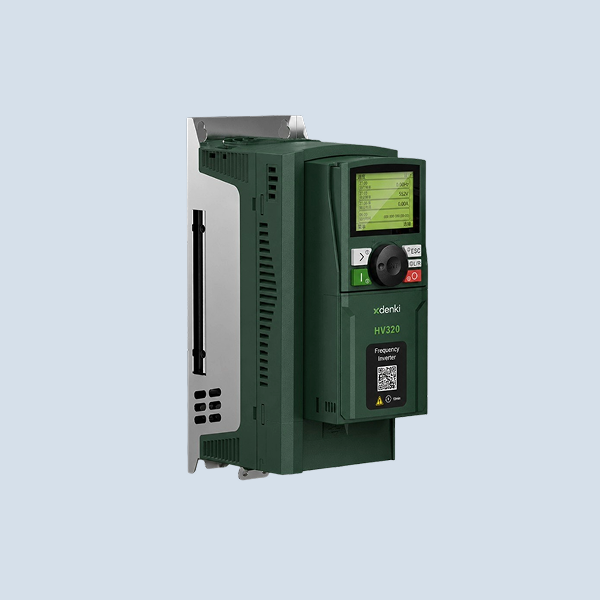
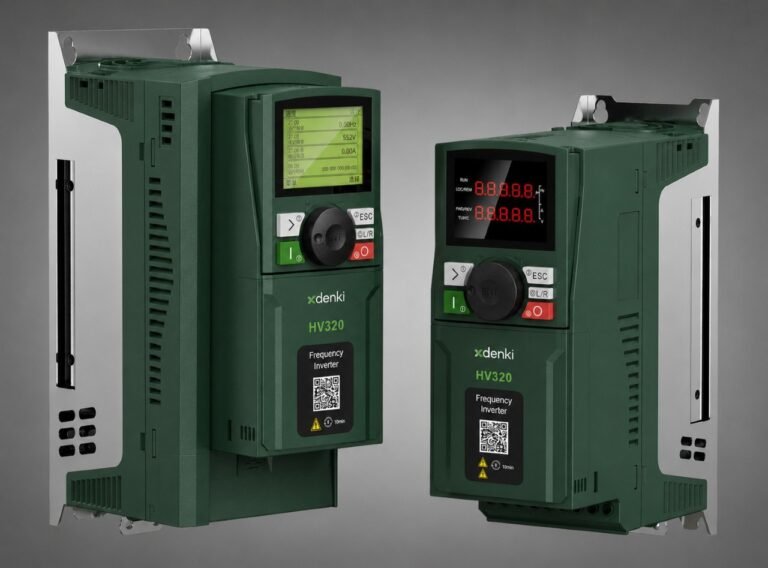
The XDENKI HV320 Series Frequency Inverter puts everything covered in this article into a single, ready-to-deploy drive. It supports both open-loop and closed-loop vector control for precise speed and torque regulation, integrates Modbus RTU with optional PROFINET, EtherCAT, and other industrial protocols, and includes built-in dual Safe Torque Off (STO) for safer operation — available across a wide 0.4–800kW power range.