Not every frequency inverter is a good fit for every application. Pick one that’s undersized, missing the right control mode, or incompatible with your existing network, and you’ll end up with nuisance trips, poor process control, or a costly redesign down the line. Here’s how to actually work through the selection process, step by step.
Start with the Motor and the Load
Before comparing brands or features, the starting point is always the motor being driven and the nature of the load. A fan or pump (a “variable torque” load) has very different demands than a conveyor, extruder, or hoist (a “constant torque” load) — the latter typically needs higher starting torque and tighter speed regulation, which affects which control mode is actually necessary.
Key Factors to Evaluate
1. Power Rating
Match the inverter’s rated power (kW/HP) to the motor it will drive — not just at nominal load, but accounting for peak or starting current demands. Undersizing an inverter is one of the most common causes of nuisance overload trips.
2. Input Voltage and Phase
Confirm the available supply — single-phase 220V, three-phase 220V, or higher-voltage three-phase systems like 380–440V or 460–480V — since inverters are typically built and rated for a specific input voltage class.
3. Control Method
Simple V/F control is often sufficient for fans and pumps. Applications needing high starting torque, precise low-speed performance, or tight speed regulation — winding, cutting, hoisting — generally require open-loop or closed-loop vector control instead.
4. Motor Type
Standard asynchronous (induction) motors remain the most common, but permanent magnet synchronous motors (PMSM) are increasingly used for higher efficiency in applications like solar pumps and specialized machinery. Confirm the inverter explicitly supports the motor type in use.
5. Communication and Integration
Check what protocols the inverter supports natively — Modbus RTU is nearly universal, but larger systems may require PROFINET, EtherCAT, PROFIBUS-DP, EtherNet/IP, or Modbus TCP to integrate cleanly with existing PLCs and SCADA systems.
6. Safety Features
For applications where a motor could pose a hazard if it started unexpectedly, a built-in Safe Torque Off (STO) function is worth prioritizing — it provides a safety-rated way to prevent motor rotation without removing power entirely, which speeds up recovery after a safety stop.
7. Environmental Conditions
Ambient temperature, dust, humidity, and vibration all affect inverter selection — particularly cooling method (fanless vs. forced-air) and enclosure rating. An inverter that performs well in a climate-controlled panel may not hold up in a hot, dusty production environment.
Rule of thumb: match power and voltage first, then control method to the load’s torque demands, then confirm communication compatibility with your existing PLC or SCADA system — in that order.
Common Mistakes to Avoid
Two mistakes come up repeatedly: sizing an inverter to a motor’s nameplate rating without accounting for starting or peak load conditions, and choosing based on price alone without confirming the required communication protocol is actually supported — which can turn a simple installation into an integration headache later. Taking the time to map out the application’s real requirements up front avoids both.
Planning for the Future
Where possible, it’s worth selecting an inverter platform — not just a single model — that spans a wide power range and supports multiple communication protocols. This makes it far easier to standardize spare parts, programming knowledge, and maintenance procedures across a facility as new machines are added over time.
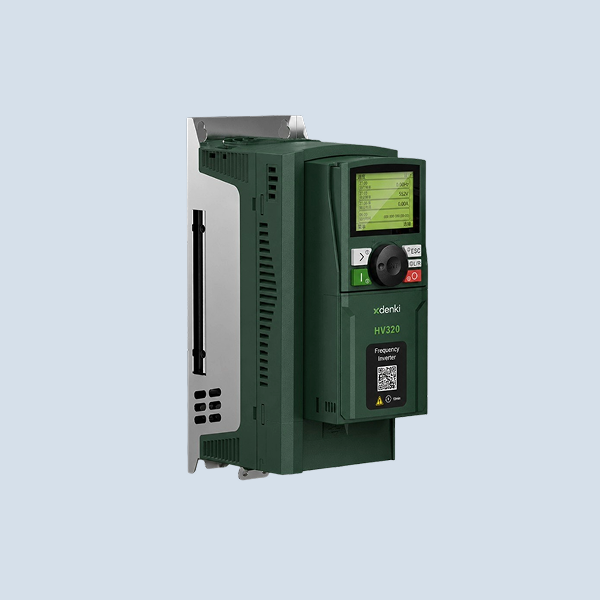
The XDENKI HV320 Series Frequency Inverter is built to cover exactly the range of requirements outlined above. It spans a 0.4–800kW power range across single-phase 220V, three-phase 220V, 380–440V, and 460–480V input classes, supports both open-loop and closed-loop vector control, includes built-in dual Safe Torque Off (STO), and offers native Modbus RTU with optional PROFINET, EtherCAT, PROFIBUS-DP, and EtherNet/IP — making it a single platform that scales across most industrial applications.