Walk through a manufacturing plant today and compare it to one from thirty years ago, and the difference isn’t just newer machines — it’s a fundamentally different relationship between people and production. Operators once manually adjusted, measured, and recorded everything by hand. Today, that same floor runs on programmed logic, real-time data, and interfaces that turn complex processes into a few taps on a screen. That shift is what industrial automation actually means in practice.
From Manual to Automated
Traditional manufacturing relied heavily on operator skill and manual intervention — starting motors by hand, adjusting valves based on experience, recording readings on paper logs. This approach worked, but it was inherently variable: output and quality depended on who was on shift, how alert they were, and how consistently they followed procedure. Automation didn’t just speed this up — it replaced variability with repeatability, running the same programmed sequence identically, cycle after cycle.
Where the Transformation Shows Up Most
Precision and Consistency
A PLC executes the same logic every cycle, without fatigue or distraction. Combined with precise motor control from frequency inverters, manufacturers can hold tolerances and process parameters far tighter than manual operation ever allowed — directly reducing defect rates and rework.
Speed and Throughput
Automated systems don’t need breaks, shift changes, or supervision to keep running. Multiple machines can be coordinated to run continuously and in sync, achieving throughput levels that would require significantly more manual labor to match — if they could be matched at all.
Real-Time Visibility
Where manufacturers once relied on periodic manual checks and end-of-shift reports, HMIs and connected monitoring systems now show what’s happening as it happens — production rates, alarm status, equipment condition — giving operators and managers a live picture instead of a delayed one.
Flexibility Between Products
Modern facilities frequently produce multiple product variants on the same line. Recalling a stored recipe or parameter set from an HMI turns what used to be an hour of manual reconfiguration into a task measured in minutes, letting manufacturers respond to demand changes far more nimbly.
Safer Working Conditions
Automation takes over many of the repetitive, hazardous, or physically demanding tasks that once required direct human involvement — reducing exposure to injury risk while also freeing people to focus on oversight, troubleshooting, and improvement work that actually benefits from human judgment.
The underlying shift: automation didn’t remove people from manufacturing — it moved them from executing repetitive tasks to overseeing, troubleshooting, and improving systems that now run themselves.
What This Means for Competitiveness
Manufacturers that automate aren’t just producing more — they’re producing more predictably, with data to back it up. That predictability translates into more reliable delivery commitments, tighter quality control, and the ability to identify and fix inefficiencies that would otherwise stay hidden in a manual process. In competitive manufacturing markets, this difference compounds over time.
Where the Transformation Continues
The next stage of this shift extends automation’s reach beyond the machine itself — connecting PLCs, HMIs, and drives to cloud platforms for remote monitoring, predictive maintenance, and facility-wide data analysis. The same transformation that moved manufacturing from manual to automated is now extending from automated to connected.
Product Spotlight
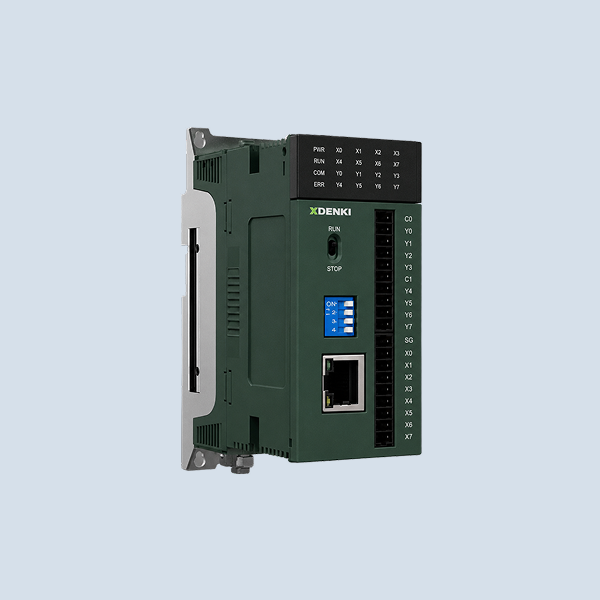
At the center of this transformation is the controller running the process, and the XDENKI HCS Series Card PLC offers a compact, cost-effective foundation for manufacturers making that shift. With built-in Ethernet and RS485 communication, integrated cloud programming, and flexible I/O configurations, it brings the consistency and visibility of modern automation to standalone machines and full production lines alike.