
Plastic processing lives and dies on temperature. A barrel zone a few degrees off, a mold that cools unevenly, a screw speed that drifts mid-cycle — any of these can turn a good part into scrap, warped, short-shot, or full of visible defects. Whether it’s injection molding or extrusion, the process is really a chain of tightly controlled physical conditions, and automation is what keeps that chain from breaking.
Why Plastics Processing Demands Precise Control
Plastic resins behave very differently depending on temperature, pressure, and shear — melting, flowing, and solidifying within specific windows that vary by material. Injection molding cycles involve rapid, repeatable sequences of injection, holding, cooling, and ejection, each with its own timing and pressure requirements. Extrusion processes run continuously, with barrel temperature zones and screw speed needing to stay stable for the full length of a production run. In both cases, the margin for error is often narrow.
Key Automation Applications
Temperature Zone Control
Extruder barrels and injection molding machines are typically divided into multiple heating zones, each needing precise, independent temperature regulation. PID control loops running on the PLC continuously adjust heating output to hold each zone within its target range, correcting for material flow, ambient conditions, and process changes in real time.
Screw Speed and Torque Control
Extruder and injection screw motors need precise speed and torque control to maintain consistent material flow and shear — directly affecting part quality and output consistency. Vector-controlled frequency inverters provide the responsive, stable motor control this requires, even as material viscosity and back-pressure change during a run.
Injection Cycle Sequencing
The PLC coordinates the full injection molding cycle — clamp, injection, hold, cooling, ejection — executing each step with precise, repeatable timing so that every part produced follows the same process conditions as the last.
Recipe and Mold Parameter Management
Facilities running multiple molds or material types benefit from storing each setup’s parameters — temperatures, pressures, timing — as a recipe recallable from the HMI, reducing setup time and the risk of manual configuration errors during mold changes.
The core dependency: plastics processing quality is fundamentally a temperature and motion control problem — precise PID loops and stable motor control aren’t optional refinements, they’re what makes consistent parts possible at all.
What Precise Control Delivers
Tight temperature and motion control translates directly into fewer defective parts — short shots, warping, inconsistent wall thickness — and less material scrapped as a result. It also supports faster, more reliable changeovers between molds or products, and reduces the energy waste that comes from temperature zones overshooting and correcting repeatedly instead of holding steady.
Product Spotlight
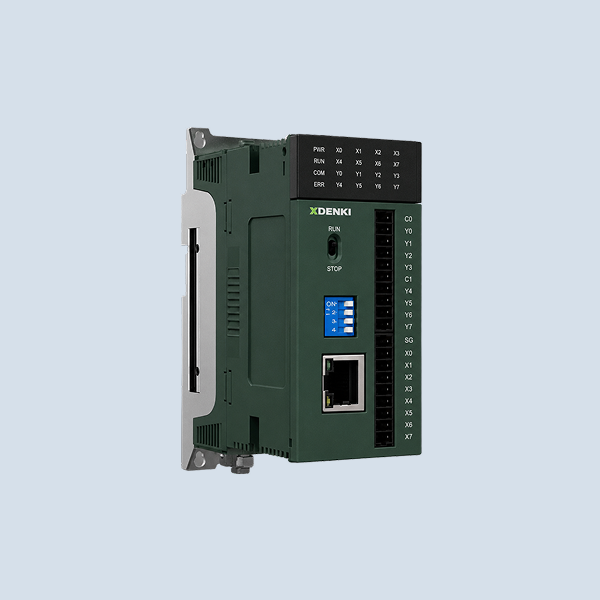
Temperature control is at the heart of plastics processing, and the XDENKI HCS Series Card PLC brings built-in PID control and temperature management capabilities directly to the controller running the process. Combined with integrated analog I/O, flexible expansion modules, and cloud-based remote diagnostics, it provides a compact, cost-effective foundation for managing the multi-zone temperature and process sequencing that plastics processing depends on.