
Textile manufacturing runs on continuous motion — yarn winding onto a spool, fabric feeding through a loom, thread unwinding under precise tension, all happening at speed and often across dozens of synchronized stages at once. A single motor running slightly too fast or too slow can mean a broken thread, an uneven weave, or a defect that isn’t visible until much later in the process. Few industries depend as directly on precise, continuous motor control as textiles.
What Makes Textile Automation Different
Unlike processes with discrete start-stop cycles, textile production is often continuous — yarn, thread, or fabric moving constantly through multiple stages that all need to stay synchronized. Tension has to be held within a narrow range to avoid breakage or distortion, speeds often need to change mid-process for different fabric types or thicknesses, and even small inconsistencies compound as material moves through stage after stage.
Key Automation Applications in Textile Production
Winding and Unwinding Tension Control
Precise motor control keeps tension consistent as yarn or thread winds onto or off a spool — critical for avoiding breakage on the tight side or slack, uneven winding on the loose side. This is one of the most tension-sensitive applications in textile manufacturing, and one where small speed inconsistencies show up immediately as defects.
Multi-Speed Process Control
Different fabrics, yarn thicknesses, and process stages often call for different operating speeds within the same production run. Drives with built-in multi-speed functions let operators switch between preset speeds quickly, without manual reconfiguration between runs.
Synchronized Multi-Motor Lines
Many textile processes involve multiple motors working in coordinated sequence — feeding, drawing, winding — each needing to run at a precisely related speed to the others. Reliable, precise motor control across every stage is what keeps material moving through the line without tension mismatches building up between stations.
High-Efficiency Motor Support
Textile facilities often run large numbers of motors continuously across long production runs, making motor efficiency a meaningful cost factor. Support for permanent magnet synchronous motors (PMSM) alongside standard asynchronous motors gives facilities a path to higher efficiency without redesigning the entire drive architecture.
The recurring theme: in textile production, motor control precision isn’t just about efficiency — it directly determines whether the material comes out defect-free.
The Business Impact
Precise, reliable motor control in textile production translates directly into fewer yarn breaks and rejected runs, less material waste, and more consistent output quality across a full production batch — all of which matter more in an industry where a single inconsistency early in the process can ripple through every downstream stage.
Product Spotlight
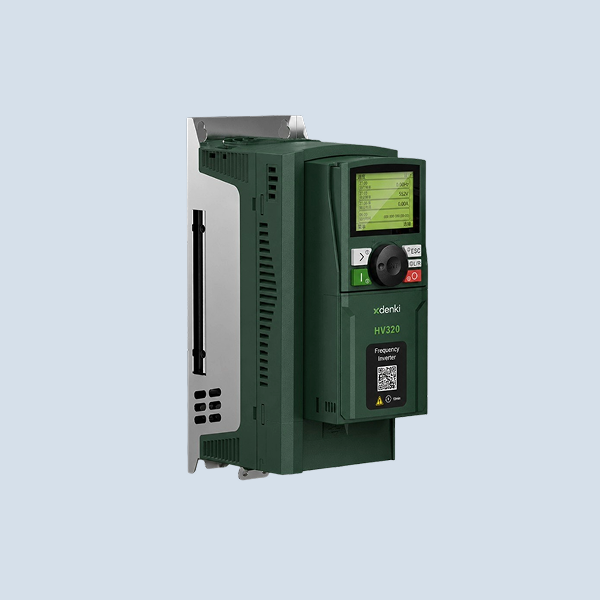
Textile production is one of the applications the XDENKI HV320 Series Frequency Inverter was specifically designed to support — with special model variants tuned for winding and unwinding, an integrated multi-speed function built for textile applications, and support for both asynchronous and permanent magnet synchronous motors. Combined with precise vector control and high starting torque, it delivers the tension-sensitive precision textile manufacturing depends on.