
Walk through most commercial or industrial HVAC systems and you’ll find the same pattern repeated across dozens of pieces of equipment: fans, pumps, and cooling towers built to handle peak demand, running at or near full speed almost all the time — even though peak demand is, by definition, rare. Variable speed drives target exactly this mismatch, equipment by equipment.
Why HVAC Equipment Is an Especially Strong Candidate
HVAC loads are almost always sized for worst-case conditions — the hottest day of the year, full occupancy, maximum outside air requirements — conditions that exist for a small fraction of total operating hours. The rest of the time, that same equipment is running at far more capacity than the building actually needs, with the excess typically wasted through mechanical throttling. This gap between “sized for” and “typically needed” is exactly where variable speed drives create value.
Where VSDs Apply Across HVAC Equipment
Air Handling Unit (AHU) Fans
Supply and return fans are frequently the largest single HVAC energy consumer in a building. A VSD lets fan speed track actual airflow demand — driven by zone temperature, CO2, or static pressure setpoints — rather than running at a fixed speed with dampers absorbing the excess.
Chilled and Hot Water Pumps
Pumping systems designed for peak cooling or heating load rarely need that much flow most of the year. VSD-controlled pumps adjust flow to match real thermal demand, reducing pumping energy substantially during partial-load periods, which make up the majority of operating hours in most climates.
Cooling Tower Fans
Cooling tower fans are classic variable-torque loads — ideal candidates for VSD control, since fan speed can be modulated based on condenser water temperature rather than cycling fans on and off at full speed.
Condenser Fans
Similarly, condenser fans in packaged and split systems benefit from speed modulation that matches heat rejection needs to actual load, rather than the abrupt full-speed cycling common in simpler fixed-speed controls.
Why the savings add up fast: for these fan and pump loads, power consumption scales roughly with the cube of speed — so equipment that spends most of its time at partial load has a disproportionately large amount of energy to save.
Certification and Incentive Programs
Variable speed drives on HVAC equipment are frequently recognized in green building certification frameworks and utility efficiency incentive programs, since the energy reduction is well-documented and relatively easy to verify. Facility managers pursuing certification or evaluating utility rebate programs should check whether VSD retrofits on major HVAC equipment qualify — the incentive can meaningfully shorten an already favorable payback period.
Retrofit vs. New Installation
VSDs can typically be added to existing HVAC motors without replacing the fan, pump, or cooling tower itself, making this one of the more accessible efficiency upgrades for existing buildings. For new installations, specifying VSD-ready motors and control architecture from the start avoids retrofit costs entirely and ensures the control strategy is integrated from day one.
Product Spotlight
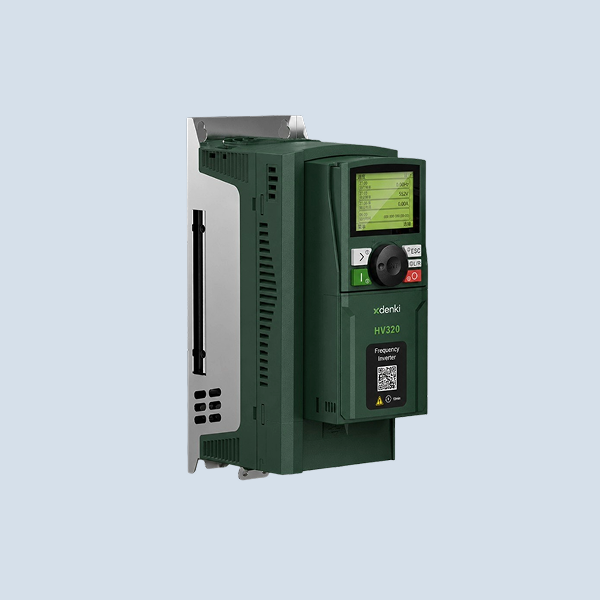
Whether the application is an AHU fan, a chilled water pump, or a cooling tower fan, the XDENKI HV320 Series Frequency Inverter provides the precise, energy-efficient speed control HVAC systems depend on. With a wide power range, reliable V/F and vector control, and intelligent motor protection, it fits both new installations and retrofits of existing equipment without a full mechanical overhaul.