PLC, HMI, and IoT gateway are three terms that get used constantly in automation — and often conflated, since all three can appear as boxes mounted in the same control panel. Technically, they perform distinct functions, operate on different time scales, and depend on different design priorities. Understanding exactly where each one’s responsibility starts and ends is essential for specifying a system correctly.
PLC: Real-Time Control Logic
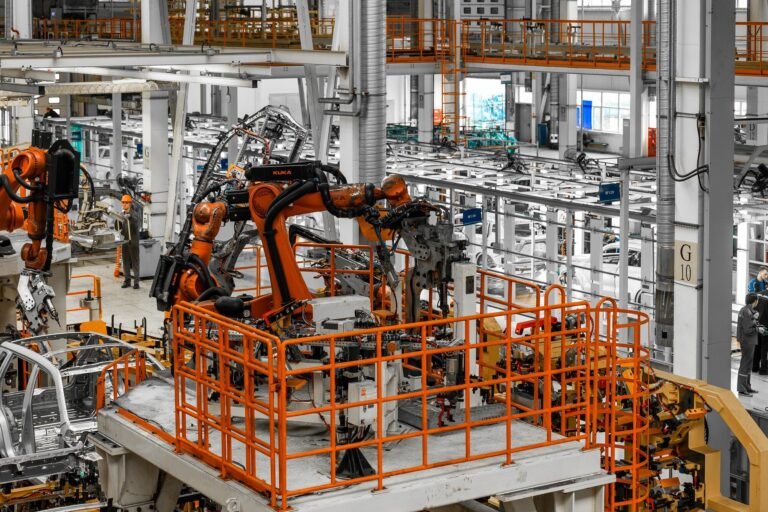
A Programmable Logic Controller executes a control program in a continuous scan cycle — reading digital and analog inputs, evaluating logic (typically Ladder Diagram, Function Block Diagram, or Instruction List under IEC 61131-3), and updating outputs, all within a deterministic scan time, often single-digit to low double-digit milliseconds. This determinism is the PLC’s defining characteristic: the same inputs reliably produce the same outputs within a predictable, bounded time window, which is what makes it suitable for direct control of motors, valves, and safety-relevant logic.
A PLC’s I/O typically includes digital inputs/outputs (DI/DO) for on/off signals, analog inputs/outputs (AI/AO) for continuous values like temperature or pressure, and communication ports (RS232, RS485, Ethernet) for connecting to drives, HMIs, and other controllers.
HMI: The Human Interface Layer
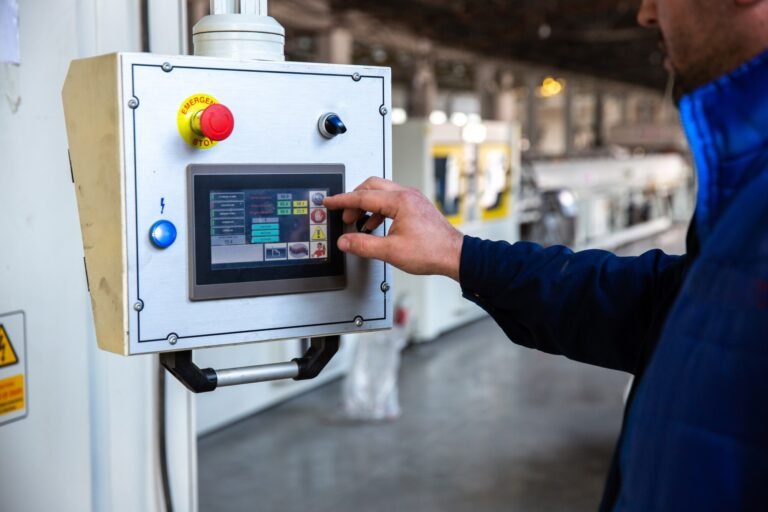
A Human-Machine Interface is a display and touch input device that communicates with the PLC — typically via Modbus, Ethernet, or a proprietary protocol — to read register values for display and write values back for operator control (setpoints, start/stop commands, mode selection). Unlike the PLC’s deterministic scan cycle, the HMI’s refresh rate is generally not safety-critical; it’s optimized for readability and responsiveness to human interaction rather than microsecond-level timing.
Modern HMIs also handle functions beyond simple display: alarm management (logging and displaying fault conditions), trend recording (historical data logging for register values over time), recipe management (storing and recalling parameter sets), and increasingly, direct cloud connectivity for remote access.
IoT Gateway: The Connectivity Layer
An industrial IoT gateway sits between existing field-level devices (PLCs, HMIs, sensors, drives) and cloud infrastructure. Its core function is protocol translation and secure data transport: reading data using the same industrial protocols the PLC and HMI already use (Modbus RTU/TCP being the most common baseline), then republishing that data using cloud-friendly protocols — most commonly MQTT — over Ethernet, Wi-Fi, or cellular connections.
Critically, the gateway operates independently of the PLC’s real-time control loop. It doesn’t participate in the deterministic scan cycle; it polls or subscribes to data at a separate, typically much slower interval suited to monitoring and reporting rather than control.
Key distinction: the PLC controls the process in real time and must keep working even with no network connection at all. The HMI and IoT gateway both depend on the PLC’s data — they observe and interact with the process, but neither one is responsible for the deterministic control loop itself.
Comparing the Three at a Glance
| Aspect | PLC | HMI | IoT Gateway |
|---|---|---|---|
| Primary role | Real-time control logic | Operator display and input | Data bridge to the cloud |
| Timing behavior | Deterministic scan cycle (ms) | Human-response refresh rate | Polling/reporting interval |
| Typical I/O | DI/DO, AI/AO, COM ports | Touchscreen, COM/Ethernet ports | RS485, Ethernet, Wi-Fi, 4G |
| Common protocols | Modbus RTU/TCP, proprietary | Modbus, Ethernet, proprietary | Modbus (field side), MQTT (cloud side) |
| Works without cloud? | Yes — fully independent | Yes — local operation unaffected | No — its function is the cloud link |
How They Interconnect
In a typical architecture, the PLC connects directly to field I/O (sensors, actuators, drives) and runs the control logic independently. The HMI connects to the PLC over a local communication link — commonly RS485 or Ethernet — reading and writing register values for operator interaction. The IoT gateway connects to the same network as the PLC and HMI, reading data via the same local protocol, then forwarding it to a cloud platform. All three can operate on the same physical network, but each is reading and writing data for a different purpose, at a different priority level.
Why the Distinction Matters When Specifying a System
Understanding these roles precisely avoids two common specification mistakes: relying on cloud connectivity for anything safety- or timing-critical (the gateway’s connection can drop; the PLC’s control loop should not depend on it), and underspecifying the HMI’s role by treating it as “just a screen” when it’s also handling alarm logging, recipes, and often the primary interface for troubleshooting on the floor.
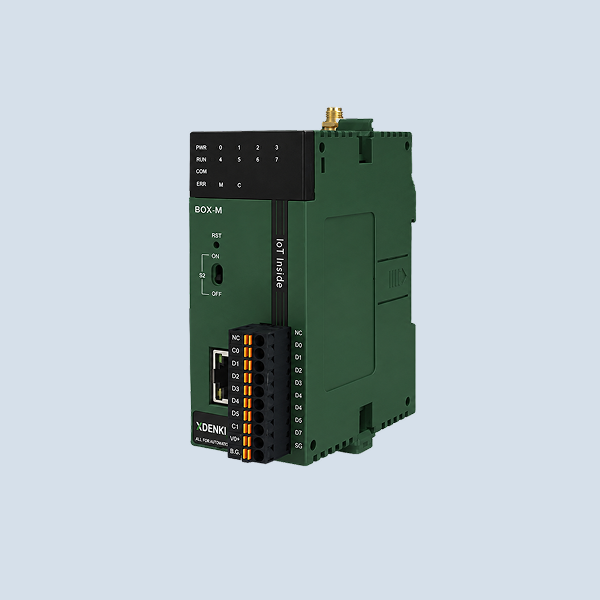
For systems that already have a PLC and HMI in place and need to add the connectivity layer described above, the XDENKI H-BOX-M Series Industrial IoT Box fills exactly that role. It reads data from existing equipment over RS232/RS485 or Ethernet using standard industrial protocols, and republishes it via native MQTT to cloud platforms — functioning purely as the gateway layer without interfering with the PLC’s local control loop.