Automation has its own vocabulary, and it’s easy to nod along in a technical conversation without being fully certain what a term actually means. This glossary covers the core terms that come up constantly across control systems, motor drives, and industrial connectivity — organized by category for quick reference.
Control & Logic
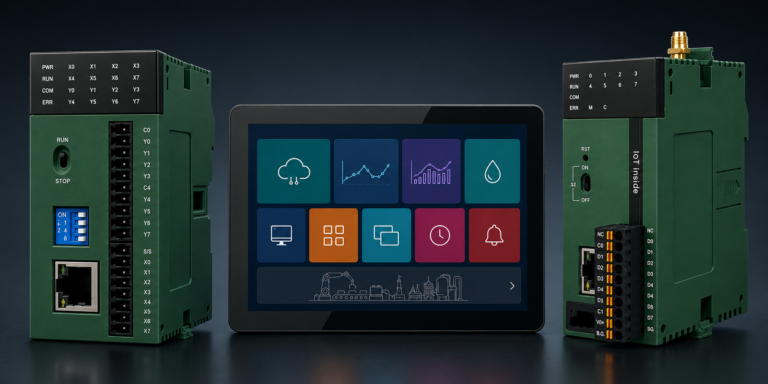
PLC (Programmable Logic Controller): An industrial computer that executes control logic in a continuous, deterministic scan cycle — reading inputs, evaluating programmed logic, and updating outputs.
Scan Cycle: The repeating sequence a PLC executes — read inputs, run logic, update outputs — typically completed in single-digit to low double-digit milliseconds.
IEC 61131-3: The international standard defining PLC programming languages, including Ladder Diagram (LD), Function Block Diagram (FBD), and Instruction List (IL).
Ladder Diagram (LD): A graphical PLC programming language that visually resembles electrical relay logic circuits — the most widely used PLC language in industrial automation.
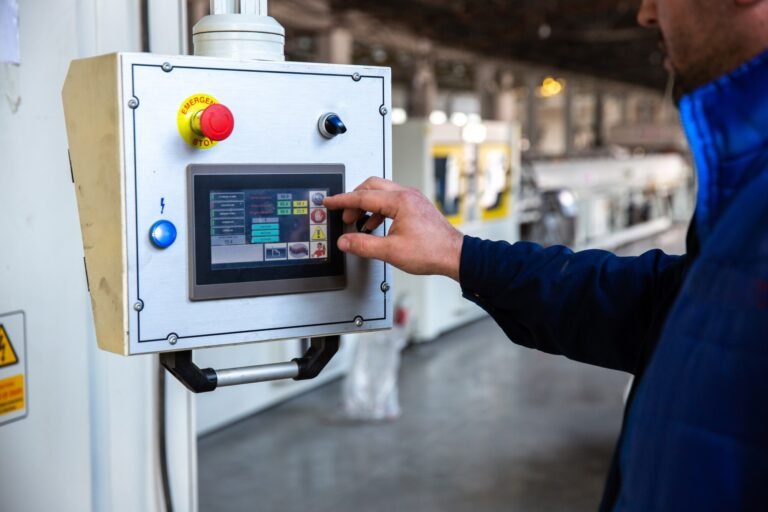
HMI (Human-Machine Interface): A touchscreen display device that lets operators view process data and control equipment, typically communicating with a PLC over Modbus or Ethernet.
I/O (Input/Output): The physical connection points on a PLC or module — Digital Input/Output (DI/DO) for on/off signals, and Analog Input/Output (AI/AO) for continuous values like temperature or pressure.
SCADA (Supervisory Control and Data Acquisition): A software system for monitoring and controlling multiple PLCs or sites from a centralized interface, typically used at a plant-wide or multi-site level above individual HMIs.
Motor Control
Frequency Inverter / VFD (Variable Frequency Drive): A device that controls AC motor speed and torque by varying the frequency and voltage of the power supplied to it.
V/F Control (Volts per Hertz): A simpler motor control method that adjusts voltage proportionally to frequency — cost-effective for fans, pumps, and other non-critical torque applications.
Vector Control: An advanced motor control method (open-loop or closed-loop) that independently regulates torque and magnetic flux, delivering higher starting torque and more precise speed regulation than V/F control.
PWM (Pulse Width Modulation): The switching technique inverters use to synthesize a variable-frequency AC output from a DC power source, by rapidly switching power transistors on and off.
DC Bus: The internal DC voltage stage inside a frequency inverter, created by rectifying incoming AC power, that supplies the inverter section which generates the motor’s output waveform.
STO (Safe Torque Off): A safety function built into many inverters that prevents a motor from generating torque without fully removing power, allowing a faster, safer restart than a full power disconnect.
IE Efficiency Class: The IEC standard classification for motor energy efficiency (IE1 through IE4), with higher numbers indicating lower electrical losses.
Communication & Networking
Modbus RTU: A widely used serial communication protocol (typically over RS485) for connecting PLCs, HMIs, drives, and sensors in industrial networks.
Modbus TCP: The Ethernet-based version of the Modbus protocol, used for higher-speed communication over standard network infrastructure.
RS485 / RS232: Common serial communication standards used in industrial equipment — RS485 supports longer distances and multi-device networks, while RS232 is typically limited to short, point-to-point connections.
PROFINET / EtherCAT / PROFIBUS-DP / EtherNet/IP: Industrial Ethernet-based communication protocols used for high-speed, deterministic data exchange between controllers, drives, and I/O devices in more advanced automation networks.
Baud Rate: The data transmission speed of a serial communication link, measured in bits per second — both ends of a connection must be configured to the same baud rate to communicate correctly.
IoT & Connectivity
IIoT (Industrial Internet of Things): The use of connected sensors, gateways, and cloud platforms to monitor and analyze industrial equipment and processes remotely.
IoT Gateway: A device that bridges field-level equipment (PLCs, HMIs, sensors) using industrial protocols, to cloud platforms using internet-friendly protocols like MQTT.
MQTT: A lightweight publish-subscribe messaging protocol widely used for transmitting IoT data efficiently over constrained or intermittent network connections.
RTU (Remote Terminal Unit): A field device that collects data from sensors and equipment and communicates it to a central monitoring or control system, often used in distributed or remote installations.
Edge Computing: Processing or analyzing data locally, close to where it’s generated, rather than sending all raw data to the cloud for processing — reduces latency and bandwidth use.
Using this glossary: most automation conversations combine terms from multiple categories — a project might involve PLC scan-cycle timing, vector control on a drive, and MQTT connectivity to the cloud, all in the same discussion.
Building Your Working Vocabulary
These terms aren’t just vocabulary — each one represents a real design decision. Choosing V/F versus vector control, Modbus RTU versus PROFINET, or a standalone PLC versus one with a built-in IoT gateway all have concrete implications for how a system performs and how it’s specified. Understanding the terms precisely is the first step to specifying and troubleshooting automation systems with confidence.
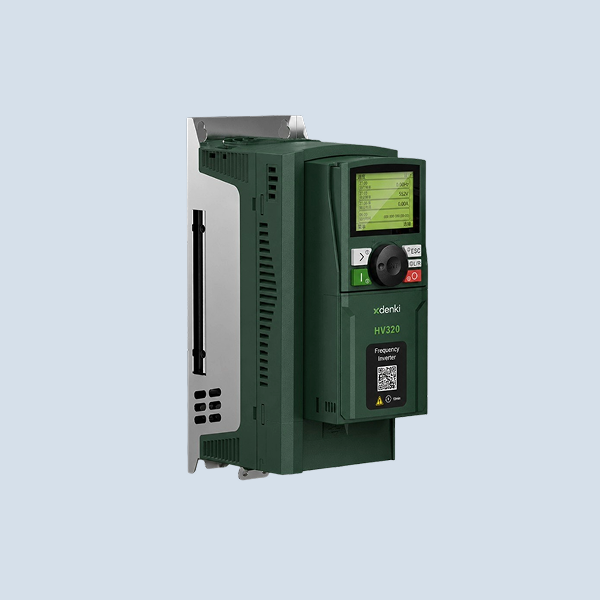
Many of the motor control terms covered above — V/F control, vector control, STO, PWM — describe real features of the XDENKI HV320 Series Frequency Inverter. It supports both V/F and open-loop/closed-loop vector control, includes built-in dual Safe Torque Off (STO), and offers native Modbus RTU with optional PROFINET, EtherCAT, and other industrial protocols — a practical reference point for seeing these concepts applied in a real device.