Most factories aren’t built from scratch — they’re built up over decades, with machines from different eras running side by side. A ten-year-old PLC might sit next to a machine that’s been running reliably since before Ethernet was common on the plant floor. The question facilities increasingly face isn’t whether to modernize, but how to connect what’s already there without replacing equipment that still works perfectly well.
Why Legacy Equipment Sticks Around
Industrial equipment is built to last, often decades longer than consumer electronics. A well-maintained motor, PLC, or machine can run reliably for 20+ years, and replacing it purely to gain connectivity — when the equipment itself still performs its core function perfectly — is rarely a good use of capital. The result is a factory floor that’s a genuine mix of old and new, and connectivity strategy has to account for that reality rather than assume a clean slate.
Where the Disconnect Happens
Older equipment typically communicates using serial protocols like RS232 or RS485, often running Modbus RTU — reliable, but not designed to talk directly to modern cloud platforms, which expect protocols like MQTT over Ethernet or Wi-Fi. Some older PLCs have no communication port at all beyond a local programming connection. This gap — between what legacy equipment speaks and what smart factory systems expect — is the core problem that needs solving, not the age of the equipment itself.
Approaches to Bridging the Gap
1. Protocol-Converting Gateways
The most common and least disruptive approach: install a gateway device that speaks the legacy equipment’s existing protocol (Modbus RTU over RS485, for example) on one side, and MQTT or another cloud-friendly protocol on the other. The legacy equipment doesn’t need to change at all — the gateway handles the translation.
2. Retrofit Sensors
For equipment with no communication capability at all, external sensors — current clamps, vibration sensors, temperature probes — can be added non-invasively to monitor condition and status without modifying the machine’s internal control system.
3. Partial Upgrades
In some cases, replacing just the HMI or adding a small networked PLC alongside existing relay logic can add connectivity without touching the core mechanical or electrical systems that are still working fine.
4. Full Replacement
Sometimes the right answer really is a full upgrade — particularly when the equipment is also nearing the end of its mechanical life, or when the process itself needs capabilities the old equipment simply can’t provide. But this should be a deliberate decision, not a default one.
In most cases: a gateway that speaks both languages is faster, cheaper, and lower-risk than replacing equipment that’s still doing its job well.
What to Look for in a Retrofit Gateway
Not every gateway is suited to legacy integration. The right device should support the specific protocols already in use on the floor (RS485/Modbus RTU is the most common baseline), offer flexible connectivity options (Ethernet, Wi-Fi, and cellular for sites without reliable network infrastructure), and include secure device identity management so newly connected legacy equipment doesn’t become an unmonitored security gap.
A Practical Starting Point
Rather than planning a facility-wide connectivity overhaul, most successful retrofits start with a single critical machine — proving the approach, learning what data is actually useful, and refining the process — before expanding gateway connectivity across the rest of the floor.
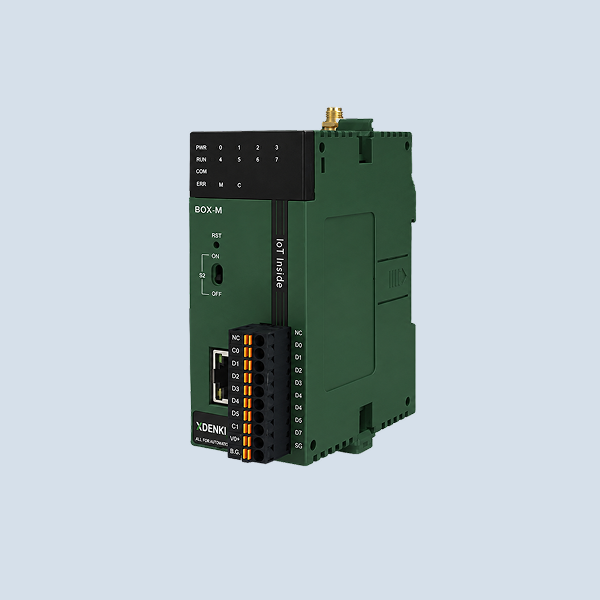
The XDENKI H-BOX-M Series Industrial IoT Box is designed specifically for this kind of retrofit. It connects to existing equipment through built-in Ethernet, RS485, and optional Wi-Fi/4G connectivity, translates data into MQTT for cloud platforms, and offers a Web API for integration with SCADA, MES, and custom dashboards — bridging legacy equipment to smart factory systems without requiring anything on the floor to be replaced.