By the time a machine actually stops, the problem behind it has usually been building for a while — a bearing slowly overheating, a motor drawing more current than it should, a process parameter quietly drifting out of range. Real-time monitoring is what makes it possible to see these changes as they happen, instead of finding out only after production has already been interrupted.
What Real-Time Monitoring Actually Means
Real-time monitoring is the continuous collection and display of live process data — temperatures, speeds, pressures, alarm states — as conditions change, rather than relying on periodic manual checks or end-of-shift reports. This can happen locally on an HMI at the machine, remotely through a cloud dashboard, or both at once, giving operators and engineers an accurate, current picture of what’s actually happening rather than what happened an hour ago.
The Core Benefits
1. Early Fault Detection
Most equipment failures don’t happen instantly — they develop over minutes, hours, or days. Real-time monitoring surfaces the early warning signs (rising temperature, increasing vibration, abnormal current draw) while there’s still time to intervene before a full breakdown occurs.
2. Reduced Unplanned Downtime
Catching problems early directly translates into fewer unexpected stoppages. Instead of discovering an issue when a machine trips mid-shift, operators can see the warning signs and schedule a fix during planned maintenance instead.
3. Faster Response Times
When an alarm does occur, real-time monitoring means it’s seen immediately — on an HMI, or pushed as a remote notification — rather than being discovered on the next walkthrough. That gap between “problem starts” and “someone notices” is often where the most preventable downtime happens.
4. Better Process Consistency
Live trend data lets operators see when a process is drifting away from its normal operating range — not just when it’s already out of spec — making it easier to hold quality steady rather than correcting after the fact.
5. Remote Visibility
When monitoring extends to the cloud, managers and engineers can check equipment status from anywhere — useful for facilities with limited on-site staff, multiple locations, or equipment that runs unattended overnight.
6. Data for Better Decisions
Beyond immediate alarms, historical trend data collected through continuous monitoring reveals longer-term patterns — recurring issues, seasonal variation, gradual equipment degradation — that inform maintenance planning and process improvements.
The underlying value: real-time monitoring shifts maintenance and response from reactive (“fix it after it breaks”) to proactive (“catch it before it breaks”) — which is consistently cheaper and less disruptive.
Local Monitoring vs. Remote Monitoring
Real-time monitoring typically happens on two levels, and the most effective setups use both. Locally, an HMI at the machine gives operators live trends, alarm status, and control in the moment — essential for immediate, on-the-floor decisions. Remotely, a cloud-connected gateway extends that same visibility to engineers, managers, or service teams who aren’t physically present, enabling faster diagnosis and support without a site visit.
Making Monitoring Useful, Not Just Available
Collecting real-time data is only half the benefit — it has to be presented in a way operators can actually act on. Clear trend displays, sensible alarm thresholds, and interfaces that highlight what matters (rather than burying it in raw numbers) are what turn real-time data into real-time decisions.
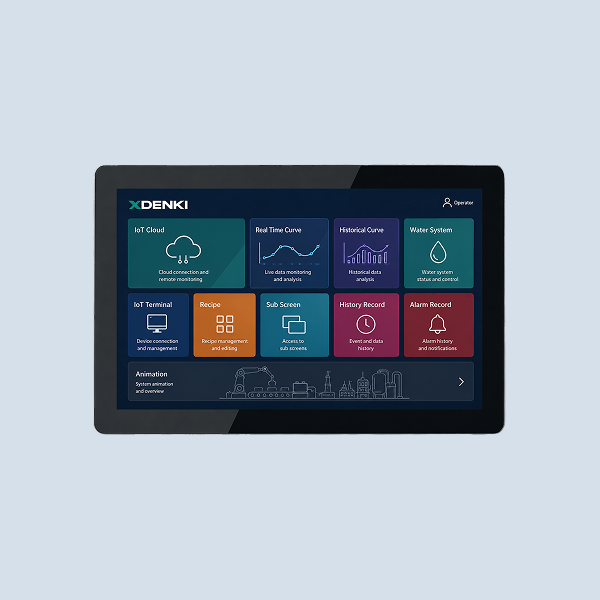
Turning raw process data into something operators can actually monitor and act on is exactly what the XDENKI HT3000-D Series IoT HMI is built for. With real-time trend screens, alarm management, and cloud connectivity built in, it puts live machine status directly in front of operators on the floor — while also enabling remote diagnostics and monitoring from anywhere.