
A packaging line is really a sequence of small, precisely timed handoffs — a product arrives, gets detected, filled, sealed, and moved on, all within fractions of a second of coordination between stations. Getting that coordination right, and giving operators a clear way to manage it, comes down to two pieces of technology working closely together: the PLC running the logic, and the HMI putting a person in control of it.
The PLC’s Role: Coordinating the Sequence
At the core of a packaging line, the PLC reads sensor inputs — product presence, position, count — and coordinates the timing of every station in response. This includes triggering fillers and sealers at the right moment, managing conveyor speed to maintain proper spacing between products, and executing safety interlocks if something falls out of sequence. None of this depends on an operator’s reaction time; it happens automatically, cycle after cycle, exactly as programmed.
The HMI’s Role: Putting People in Control
While the PLC handles the moment-to-moment logic, the HMI is where operators actually manage the line — starting and stopping production, selecting product formats, monitoring performance, and responding to alarms. A well-designed HMI turns what’s happening inside the PLC into something an operator can understand and act on immediately, without needing to interpret raw data or guess what a fault code means.
Key Capabilities That Make Packaging Lines “Smart”
Recipe and Format Management
Packaging lines frequently switch between product sizes and formats. Storing each format’s parameters as a recipe — recallable instantly from the HMI — turns a changeover that once took significant manual reconfiguration into a task measured in minutes.
Clear Alarm Management
When a fault occurs — a jam, a missing product, a sensor misread — clear, specific alarm messages on the HMI let operators diagnose and resolve the issue quickly, rather than searching through the entire line to find what stopped it.
Performance and OEE Visibility
Modern HMIs can track and display real-time production counts, downtime causes, and cycle rates, giving operators and managers visibility into line performance without needing separate manual tracking sheets.
Remote Diagnostics
Where the HMI includes cloud connectivity, engineers or service teams can review production data and alarm history remotely — useful for troubleshooting recurring issues or supporting a line without requiring an on-site visit for every question.
The division of labor: the PLC handles the split-second coordination that a person couldn’t keep up with manually; the HMI turns that automated process into something a person can actually understand, manage, and improve.
Why This Combination Matters More in Packaging
Packaging lines tend to run at high speed with frequent format changes and multiple coordinated stations — a combination that makes both precise PLC logic and a genuinely usable HMI more important than in slower, single-machine processes. A line that’s fast but hard for operators to manage tends to lose more time to changeovers and troubleshooting than the raw speed gains actually deliver.
Product Spotlight
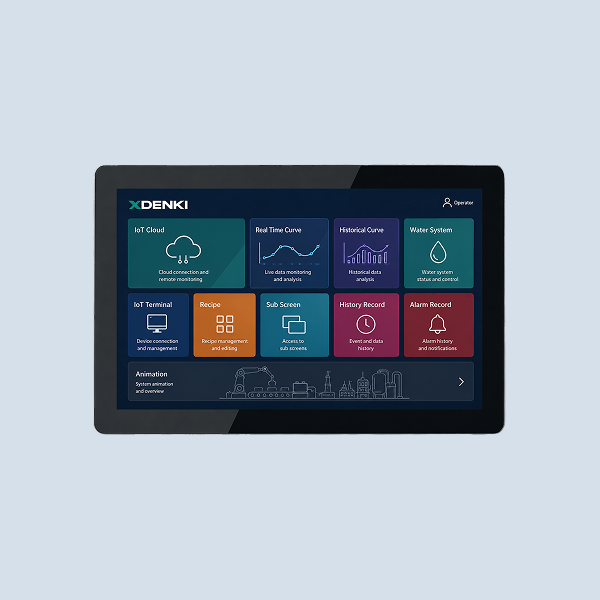
Giving operators real control over a fast-moving packaging line starts with the interface, and the XDENKI HT3000-D Series IoT HMI is built for exactly that. With built-in recipe management, clear alarm handling, historical data logging, and cloud connectivity for remote diagnostics, it turns complex PLC-coordinated packaging processes into something operators can manage confidently, changeover after changeover.