A decade ago, checking on a machine meant walking to it. Today, an engineer can see that same machine’s status, performance data, and alarm history from a phone, on the other side of the world. That shift — connecting physical industrial equipment to the internet so it can be monitored, analyzed, and managed remotely — is what the Industrial Internet of Things, or IIoT, actually means.
Defining Industrial IoT
Industrial IoT refers to the network of sensors, controllers, gateways, and software that connects physical industrial equipment — machines, PLCs, HMIs, drives — to cloud platforms and data systems. Unlike consumer IoT, which focuses on convenience (smart speakers, connected thermostats), IIoT is built around reliability, safety, and operational visibility in demanding industrial environments.
How IIoT Differs from Consumer IoT
The underlying idea — connecting physical devices to the internet — is similar, but the requirements are very different. Industrial environments demand equipment that can withstand vibration, temperature extremes, and electrical noise; communication that can’t simply drop a connection without consequence; and security that protects not just data, but physical processes that could cause real harm if compromised. IIoT devices are built and rated for these conditions in a way consumer devices generally aren’t.
The Core Building Blocks of an IIoT System
1. Sensors and Field Devices
The data source — measuring temperature, pressure, vibration, position, or any other process variable that matters to the operation.
2. PLCs and Local Controllers
Handle the real-time control logic on-site, independent of any cloud connection — the local process keeps running even if remote connectivity is temporarily lost.
3. IoT Gateways
The bridge between existing field equipment and the cloud. A gateway collects data from PLCs, HMIs, and sensors — often using their existing industrial protocols — and forwards it securely to a cloud platform, without requiring the field equipment itself to be replaced.
4. Connectivity
Ethernet, Wi-Fi, or cellular (4G) connections carry data from the gateway to the cloud, with MQTT being one of the most widely used protocols for this purpose due to its lightweight, reliable design for constrained industrial networks.
5. Cloud Platform and Analytics
Where data is stored, visualized, and analyzed — powering dashboards, alarm notifications, historical trend analysis, and increasingly, predictive maintenance models.
In short: IIoT doesn’t replace traditional automation — it extends it, adding a connectivity and data layer on top of PLCs, HMIs, and drives that were already running the process.
What IIoT Actually Enables
Remote Monitoring
Checking equipment status, performance, and alarms from anywhere, without needing to be physically on-site — valuable for facilities with limited staff or equipment spread across multiple locations.
Predictive Maintenance
Analyzing trends in temperature, vibration, or runtime data to flag developing issues before they cause a breakdown, shifting maintenance from a fixed schedule to actual equipment condition.
Faster Remote Diagnostics
When something goes wrong, engineers can often diagnose — and sometimes resolve — the issue remotely, cutting the time and cost of dispatching a technician to site.
Data-Driven Decisions
Aggregated production data across machines and shifts reveals patterns that aren’t visible looking at any single machine in isolation — informing decisions about maintenance, scheduling, and process improvement.
IIoT and Industry 4.0
IIoT is often described as one of the core technologies underpinning Industry 4.0 — the broader shift toward smart, connected, data-driven manufacturing. Where traditional automation focuses on controlling a single machine or line, IIoT extends that visibility and control across an entire facility, or even across multiple facilities, tying local control systems into a connected, analyzable whole.
Getting Started Without a Full Overhaul
Adopting IIoT doesn’t require replacing existing PLCs, HMIs, or machines. The most practical starting point for most facilities is adding an IoT gateway that connects to equipment already in place, using the protocols it already speaks — extending visibility to the cloud without disrupting the process that’s already running reliably.
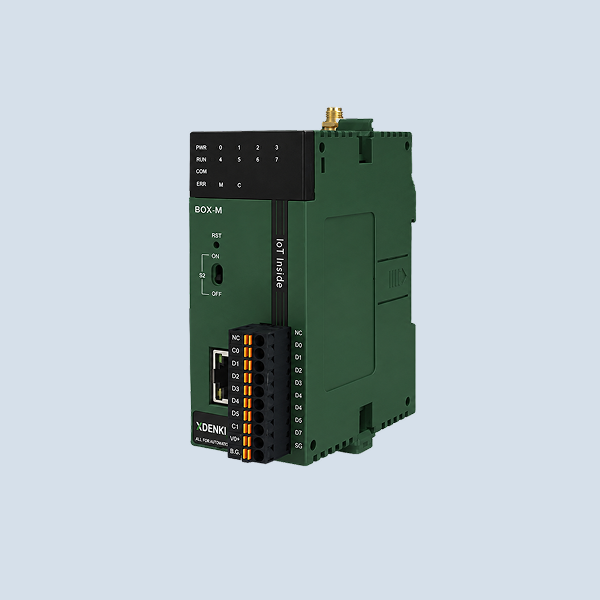
The XDENKI H-BOX-M Series Industrial IoT Box is exactly the kind of gateway described above — combining RTU functionality, an IoT gateway, and cloud communication in one compact device. It connects to existing PLCs, HMIs, and sensors using standard industrial protocols, supports native MQTT communication, and enables real-time monitoring, remote diagnostics, and alarm notifications — a practical first step into Industrial IoT without replacing equipment already in place.