Maintenance has traditionally followed one of two paths: fix it after it breaks, or fix it on a fixed schedule whether it needs it or not. Both waste money in different ways — one through unplanned downtime, the other through unnecessary service on equipment that was still running fine. Industrial IoT makes a third option practical at scale: maintaining equipment based on its actual condition, not a guess or a calendar.
Three Approaches to Maintenance
It helps to be precise about the terms, since they’re often used loosely:
- Reactive maintenance — repairing equipment after it fails. Simple, but expensive in downtime and often in collateral damage to other components.
- Preventive maintenance — servicing equipment on a fixed schedule (e.g., every 3 months), regardless of its actual condition. Reduces failures but often means paying for maintenance that wasn’t yet needed.
- Predictive maintenance — using real data about equipment condition to service it exactly when it needs it, and not before. This is what IIoT makes practical at scale.
How IIoT Makes Predictive Maintenance Possible
1. Continuous Data Collection
Sensors and PLCs already measure temperature, current, vibration, and runtime hours — IIoT gateways collect this data continuously and forward it to a central platform, rather than letting it exist only briefly on a local HMI display.
2. Historical Trend Analysis
A single reading rarely tells you much — but a trend does. IIoT platforms store data over time, making it possible to see a bearing’s vibration signature slowly increasing over weeks, long before it would trigger an immediate alarm.
3. Threshold and Anomaly Alerts
Rather than requiring someone to actively watch a dashboard, systems can be configured to flag values that drift outside normal ranges automatically — surfacing developing issues without constant manual review.
4. Remote Diagnostics
When an anomaly is flagged, engineers can often review detailed data remotely to assess severity and plan a response — deciding whether it needs immediate attention or can wait for the next scheduled visit, without dispatching someone just to check.
5. Fleet-Wide Visibility
For organizations with equipment across multiple lines or sites, IIoT platforms aggregate condition data across the entire fleet, making it possible to prioritize maintenance resources where they’re actually needed most, rather than treating every machine identically.
The shift in mindset: predictive maintenance isn’t about predicting the future perfectly — it’s about replacing guesswork and fixed schedules with actual equipment condition data.
The Business Case
Predictive maintenance typically reduces cost from two directions at once: fewer unplanned failures (and the downtime, expedited parts, and secondary damage that come with them), and less unnecessary preventive service on equipment that didn’t actually need it yet. Over time, this also tends to extend the usable life of equipment, since problems are caught and corrected before they cause cascading damage to other components.
Getting Started
Predictive maintenance doesn’t require replacing existing machines or control systems. The practical starting point is connecting existing PLCs, HMIs, and sensors to an IoT gateway that can collect and forward their data — then building visibility gradually, starting with the equipment most critical to production, before expanding to the rest of the facility.
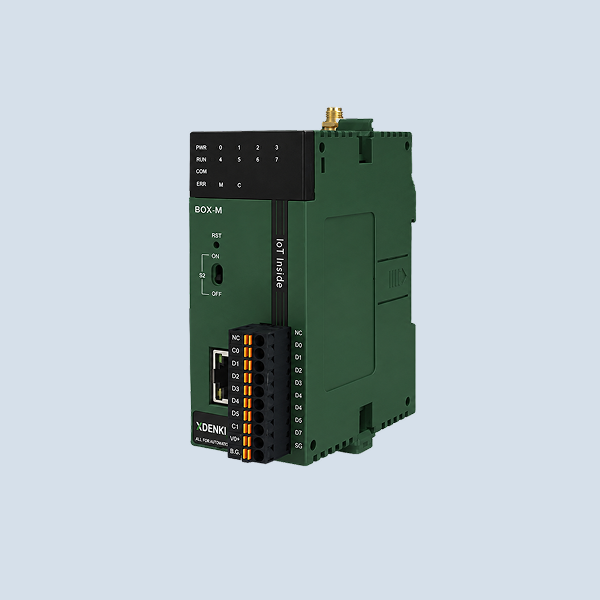
Predictive maintenance starts with reliable data collection, and the XDENKI H-BOX-M Series Industrial IoT Box is built for exactly that role. It connects to existing PLCs, HMIs, and sensors, transmits data securely to the cloud via native MQTT, and provides real-time alarm notifications and remote diagnostics — giving maintenance teams the condition data they need without replacing equipment already on the floor.