Few industries demand as much precision and consistency as food and beverage production. A batch that’s slightly off in temperature, mixing time, or ingredient ratio isn’t just a quality issue — it can mean an entire batch discarded, a regulatory problem, or worse. Automation has become less of an upgrade and more of a baseline requirement for producers trying to meet these demands reliably, day after day.
What Makes Food & Beverage Automation Different
Automation in food and beverage production has to satisfy requirements that don’t apply the same way in other industries: strict hygiene and washdown resistance, precise recipe control, full batch traceability for regulatory compliance, and the ability to switch quickly between products without contaminating the next batch. General-purpose automation equipment often isn’t enough — it needs to be selected with these specific demands in mind.
Key Applications of Automation in Food & Beverage
1. Mixing and Dosing
Precise control over ingredient ratios, mixing time, and mixing speed directly determines product consistency. PLC-controlled dosing systems apply the exact same recipe every time, eliminating the variability that comes with manual measurement.
2. Temperature and Process Control
Cooking, pasteurization, fermentation, and cooling processes are highly temperature-sensitive. Automated temperature control keeps these processes within tight tolerances — critical for both product quality and food safety.
3. Filling and Packaging
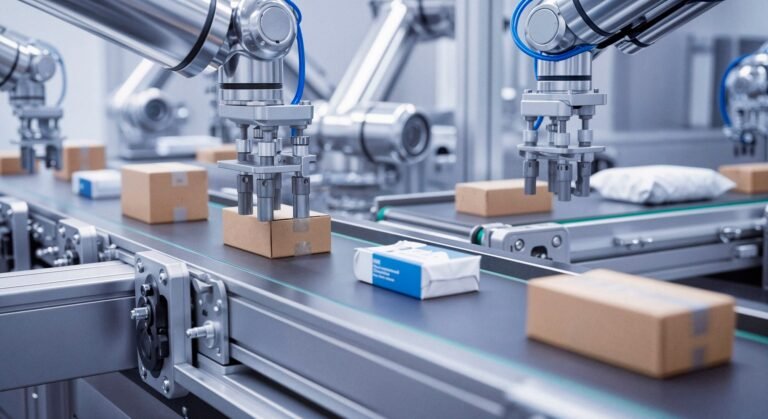
Precise motor control on filling lines and packaging machinery ensures consistent fill levels and packaging speed, directly affecting both waste (overfilling) and compliance (underfilling) — while frequency inverters allow line speed to be matched exactly to downstream equipment.
4. Recipe and Batch Management
Producers often run multiple products or flavors on the same line. Storing each product’s parameters as a recipe that can be recalled instantly — rather than manually reconfigured — dramatically speeds up changeovers and eliminates configuration errors between batches.
5. Traceability and Compliance
Regulatory requirements increasingly demand the ability to trace a finished product back to its batch, ingredients, and process parameters. Automated data logging captures this information as a byproduct of normal operation, rather than requiring separate manual record-keeping.
The bottom line: in food and beverage production, automation isn’t just about speed — it’s about repeatability, traceability, and food safety, all of which depend on precise, consistent process control.
Reducing Waste Through Precision
In food and beverage production, waste isn’t just a cost issue — ingredients, energy, and often perishable product are all lost when a batch has to be discarded. Precise automated dosing, mixing, and temperature control directly reduce the frequency of off-spec batches, while accurate fill control on packaging lines reduces product giveaway from overfilling.
Remote Visibility Across Shifts and Sites
Many food and beverage facilities run multiple shifts or multiple production sites. Cloud-connected monitoring allows quality and operations teams to check process parameters, alarm history, and production data remotely — supporting both day-to-day oversight and the audit trail regulators expect.
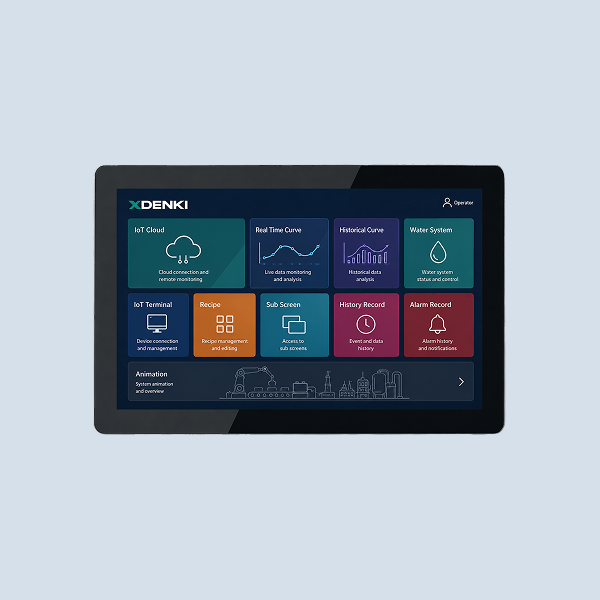
Recipe management and fast, reliable changeovers are central to food and beverage production, and the XDENKI HT3000-D Series IoT HMI is built to support exactly that. With built-in recipe management, historical data logging, multilingual interfaces for diverse production teams, and cloud connectivity for remote oversight, it gives operators the tools to switch between products confidently while keeping a clear record of every batch.