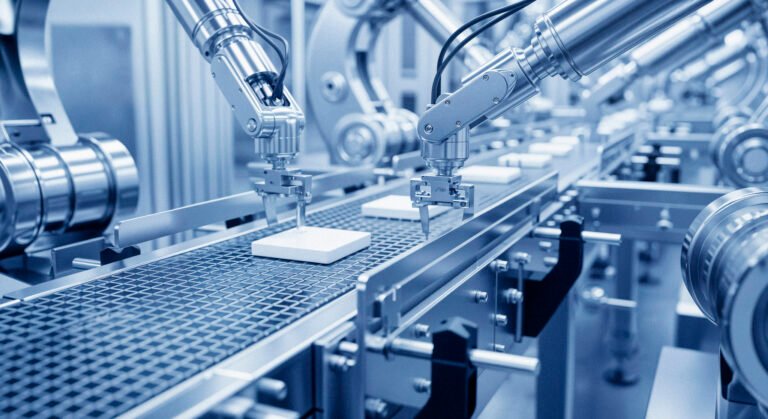
Ask any plant manager what matters most, and the answer usually comes down to two things: producing more, and producing it right. Automation directly targets both — not through a single dramatic change, but through dozens of small improvements in speed, consistency, and control that add up across every shift, every day.
Productivity and Quality Are Connected
It’s tempting to treat “more output” and “better quality” as competing goals — push speed too hard, and defects go up. Automation is one of the few investments that improves both at once, because a well-controlled process doesn’t have to trade accuracy for speed. A properly tuned automated system runs fast and consistent, precisely because the consistency is what allows the speed.
How Automation Drives Productivity
1. Continuous, Unattended Operation
Automated systems don’t need breaks, shift changes, or supervision to keep running. A PLC-controlled process can operate reliably across shifts, weekends, and unattended hours, directly increasing the total output a facility can produce without adding labor.
2. Faster Cycle Times
Automated motion and motor control — particularly with frequency inverters and precise vector control — can run processes closer to their true mechanical limits than manual operation ever could, without sacrificing repeatability.
3. Reduced Unplanned Downtime
Real-time monitoring through HMIs and IoT gateways surfaces small issues — an overheating motor, a drifting sensor reading — before they become full stoppages. Catching problems early is often the single biggest productivity gain automation provides.
4. Faster Changeovers
Switching between product variants manually can take significant time to reconfigure settings. With automation, a stored recipe or program can be recalled on an HMI in seconds, cutting changeover time and getting the line back to full output faster.
The key idea: automation doesn’t just make a process faster — it removes the gaps and inconsistencies that were slowing it down in the first place.
How Automation Improves Quality
1. Eliminating Human Variability
Two operators rarely perform a manual task in exactly the same way — and even the same operator varies from one hour to the next. A PLC executes the same logic every single cycle, removing that variability entirely from the equation.
2. Precise Process Control
Frequency inverters with vector control regulate motor speed and torque far more precisely than fixed-speed operation, directly improving the consistency of processes like mixing, cutting, winding, or conveying — where speed variation shows up as product defects.
3. Real-Time Correction
Sensors continuously feed data back to the PLC, allowing the system to adjust in real time — correcting speed, temperature, or position before a defect occurs, rather than catching it during inspection after the fact.
4. Traceability and Data Logging
Automated systems can log production data automatically — batch numbers, process parameters, alarm history — making it far easier to trace a quality issue back to its root cause than relying on manual paper logs.
A Simple Example
Consider a conveying or winding process where motor speed directly affects tension and product consistency. Run at a fixed speed with a basic motor starter, small variations in load or friction cause speed to drift, leading to uneven product. Add a frequency inverter with closed-loop vector control, and the system continuously corrects for those variations — holding speed steady regardless of load changes. The result is a process that runs faster with fewer rejects, not one or the other.
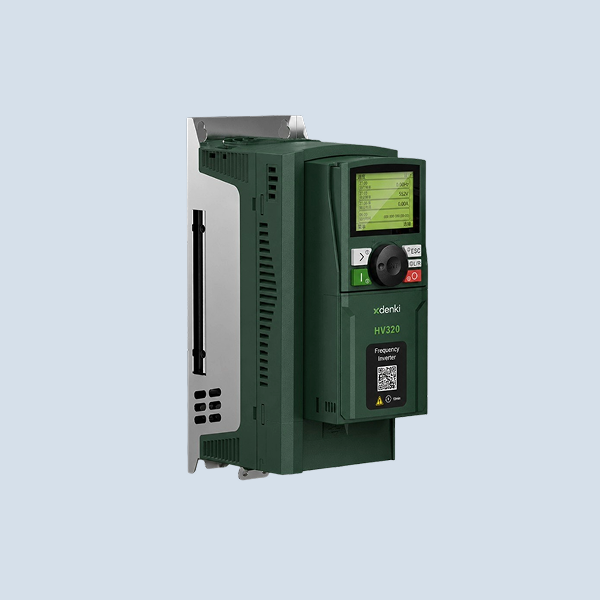
Precise motor control is one of the most direct ways automation improves both throughput and product quality, and the XDENKI HV320 Series Frequency Inverter is built for exactly that. With advanced open-loop and closed-loop vector control, high starting torque, and precise speed regulation across a 0.4–800kW range, it keeps demanding processes running fast, stable, and consistent — even under varying load conditions.