Automation promises fewer errors, higher throughput, and better visibility — but getting there isn’t always straightforward. Most automation projects run into the same handful of obstacles, whether it’s a single machine upgrade or a facility-wide rollout. Knowing what to expect makes it far easier to plan around these challenges instead of being surprised by them.
Why Automation Projects Get Complicated
On paper, adding a PLC, an HMI, and a few sensors sounds simple. In practice, real facilities have existing equipment, existing workflows, and real operators who need to keep production running while changes happen around them. Most of the friction in automation projects comes from that gap between the ideal plan and the messy reality of an active production environment.
The Most Common Challenges
1. Integrating with Legacy Equipment
Few facilities are starting from a blank slate. Older machines often use outdated protocols, proprietary interfaces, or no digital communication at all. Bridging these systems with modern PLCs, HMIs, and cloud platforms — without a full equipment replacement — is one of the most common and most underestimated challenges in any automation project.
2. Minimizing Production Downtime
Installing or upgrading automation almost always requires some downtime, but production schedules rarely leave much room for it. Planning installation in phases, during scheduled maintenance windows, or line by line instead of all at once is usually the difference between a smooth rollout and a costly disruption.
3. Skills Gaps and Training
New automation systems are only as effective as the people operating and maintaining them. Operators need to be comfortable with new HMIs, and technicians need to understand PLC logic well enough to troubleshoot issues — not just during commissioning, but for years afterward. Underinvesting in training is a common reason new systems underperform their potential.
4. Justifying the Investment (ROI)
Automation equipment carries real upfront cost, and the payback isn’t always immediately obvious to decision-makers outside the engineering team. Building a clear case — reduced scrap, lower energy use, fewer unplanned stops, reduced labor for repetitive tasks — is often necessary just to get a project approved, let alone completed.
5. Cybersecurity and Remote Access
As more equipment gets connected to networks and the cloud, it also becomes a potential entry point for security risks. Automation projects increasingly need to account for secure remote access, device identity management, and network segmentation — considerations that weren’t as relevant when equipment ran in isolation.
6. Planning for Scalability
A system designed only for today’s needs often becomes a bottleneck within a few years. Choosing controllers, HMIs, and network architecture with room to add I/O points, additional machines, or new communication protocols later on avoids a costly redesign down the line.
The common thread: most automation challenges aren’t really technical — they’re about planning for real-world constraints: existing equipment, existing people, and existing schedules.
How to Reduce the Risk
Most of these challenges can be significantly reduced with the right approach: start with a clearly scoped pilot rather than a facility-wide overhaul, choose equipment that supports standard, widely-used communication protocols, and involve operators and maintenance staff early rather than after the system is already installed. Equipment that’s designed for flexible integration — rather than requiring everything to be replaced at once — also makes a measurable difference in how smoothly a project goes.
Bridging Old and New Without a Full Overhaul
One of the most practical ways to address several of these challenges at once — legacy integration, remote visibility, and cybersecurity — is to add an intermediary device between existing equipment and the cloud, rather than replacing the equipment itself. This is exactly the role an industrial IoT gateway plays: it connects to existing PLCs, HMIs, and sensors using their current protocols, and exposes that data securely to remote monitoring platforms.
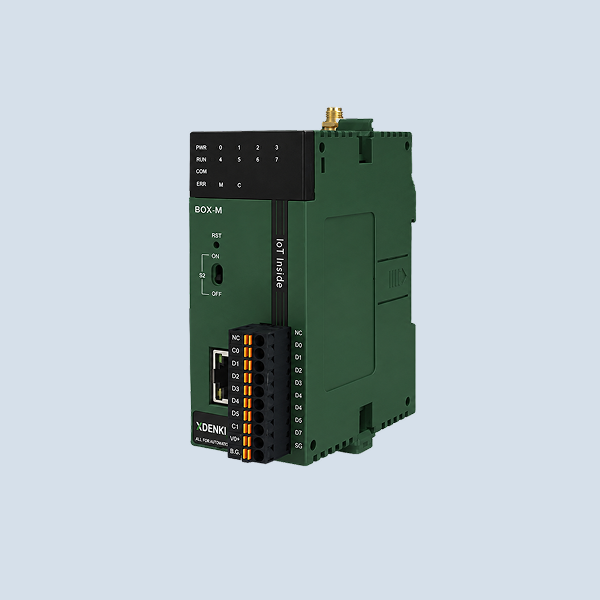
For projects facing legacy integration or remote-visibility challenges, the XDENKI H-BOX-M Series Industrial IoT Box offers a straightforward path forward. It combines RTU functionality, an IoT gateway, and secure cloud connectivity in one compact device — connecting to existing PLCs, HMIs, and sensors without requiring a full equipment replacement, while enabling remote monitoring, diagnostics, and alarm notifications from anywhere.